
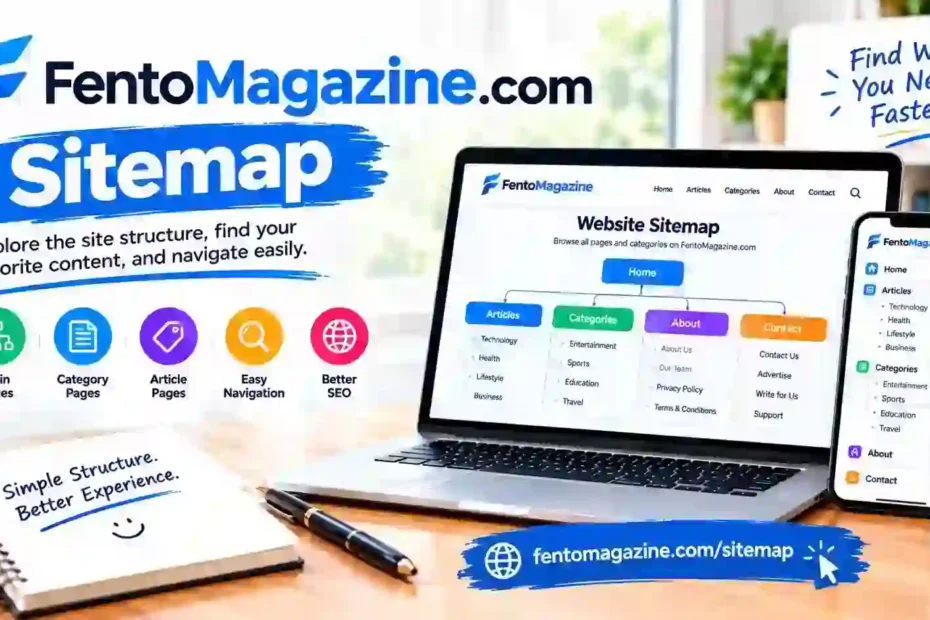
Struggling to locate specific articles or sections on the magazine? Wasting minutes clicking through endless pages drains your patience and causes you to miss valuable content. The fentomagazine com sitemap solves this problem instantly by organizing every URL, category, and resource into one navigable structure. This guide walks you through the complete site layout so you find exactly what you need.
What Is the Fentomagazine Com Sitemap and Why Does It Matter?
For any website, a sitemap serves as a road map. The fentomagazine com sitemap lists every published page, post, and media file in a structured format that both humans and search engines read easily.
Without this map, visitors bounce between unrelated pages hoping to stumble upon the right article. When a website lacks clear internal linking and URL arrangement, search engine crawlers encounter the same issue.
Google’s own Search Central documentation confirms that sitemaps directly improve crawling efficiency, especially for content-rich platforms like digital magazines (developers.google.com/search/docs/crawling-indexing/sitemaps/overview).
The fentomagazine com sitemap matters because it connects readers to fresh stories, editorial columns, and multimedia features without unnecessary clicks.
How Does the Fentomagazine Com Sitemap Improve Content Discovery?
Content discovery drives engagement on any publishing platform. When fentomagazine.com organizes its pages through a clear sitemap, readers locate niche topics faster.
The sitemap groups articles by publication date, category, and author name. This structure helps a reader who searches for a specific interview or opinion piece jump straight to the right section.
Search engines also benefit. Googlebot reads the sitemap to understand which pages hold the most recent updates. This accelerates indexing and pushes fresh fentomagazine.com content into search results sooner.
- Readers find archived articles within seconds
- New posts appear in search indexes faster
- Internal page relationships become visible to crawlers
- Bounce rates drop because visitors reach relevant content quickly
What Pages Does the Fentomagazine Com Sitemap Include?
The fentomagazine com sitemap covers every live URL on the platform. This includes the homepage, category archives, individual article pages, author profiles, and static informational pages.
You will find editorial sections broken down by topic verticals such as lifestyle, technology, culture, and current affairs. Each vertical contains dozens to hundreds of individual post URLs.
Static pages like the contact form, privacy policy, and the fentomagazine com about us page also appear in the sitemap. These pages rarely change but still require proper indexing for site credibility.
Media files including featured images, embedded videos, and downloadable PDFs may also carry their own sitemap entries depending on the CMS configuration.
How Can You Access the Fentomagazine Com Sitemap Directly?
Most websites host their XML sitemap at a predictable URL. For fentomagazine.com, you typically access the sitemap by appending “/sitemap.xml” to the root domain in your browser address bar.
Type fentomagazine.com/sitemap.xml and press enter. The browser displays a structured list of URLs formatted in XML markup.
If the site uses an HTML sitemap for human visitors, you may find a link in the footer navigation labeled “Sitemap” or “Site Map.” This version presents clickable links organized by category rather than raw code.
Some content management systems generate sitemap index files that link to multiple sub-sitemaps. In that case, the main sitemap file points to separate files for posts, pages, images, and videos.
What Role Does Fentomagazine.com Play in Digital Publishing?
Fentomagazine.com operates as a digital-first publication covering diverse editorial verticals. The platform publishes original reporting, feature stories, opinion columns, and multimedia content for a global audience.
Digital magazines like fentomagazine.com compete with traditional print outlets by delivering real-time updates and interactive storytelling. The site structure must support rapid content deployment without sacrificing navigation clarity.
The editorial team behind fentomagazine.com maintains consistent publishing schedules across multiple categories. This volume of content makes a well-organized sitemap essential for both reader experience and search visibility.
The fentomagazine com about us page provides background on the publication’s mission, editorial standards, and team credentials. Readers who want to verify the source’s credibility start there.
Where Is the Fentomagazine Com About Us Section Located?
The fentomagazine com about us page sits within the main navigation menu or the site footer. This page outlines the publication’s history, editorial philosophy, and key team members.
Transparency builds trust. When readers visit the about us section on fentomagazine.com, they see author bios, editorial policies, and contact information that confirm the publication operates with journalistic integrity.
Google’s E-E-A-T guidelines reward websites that clearly display authorship and organizational credentials. The about us page directly supports these trust signals by naming real editors and linking to their published work.
- Author names and professional backgrounds
- Editorial mission and content standards
- Physical or digital office location
- Contact email and social media profiles
How Does the Sitemap Help Search Engines Crawl Fentomagazine.com?
Search engine bots follow links to discover new pages. The fentomagazine com sitemap gives these bots a complete inventory of URLs so they skip the guesswork.
According to the Sitemaps.org protocol specification, a properly formatted XML sitemap tells crawlers which pages exist, when they last changed, and how frequently they update (sitemaps.org/protocol.html).
For a content-heavy site like fentomagazine.com, this matters enormously. Hundreds of articles publish each month. Without a sitemap, crawlers might miss newer posts buried deep within category archives.
The sitemap also communicates priority levels. High-priority pages such as the homepage and major category hubs receive more frequent crawl attention than older archive pages.
What Categories and Topics Appear in the Site Structure?
The fentomagazine.com site structure organizes content into clearly defined editorial categories. Each category functions as a content hub that groups related articles under a single URL path.
Common verticals include lifestyle, entertainment, technology, health, business, and culture. Sub-categories may further refine topics within each vertical for granular navigation.
This hierarchical structure mirrors the sitemap layout. Parent category URLs sit at the top level, while individual article URLs nest beneath them.
- Lifestyle: Fashion, travel, food, wellness
- Technology: Gadgets, software, AI trends, cybersecurity
- Culture: Art, music, film, literature
- Business: Startups, finance, markets, entrepreneurship
- Health: Nutrition, fitness, mental health, medical research
How Often Does the Fentomagazine Com Sitemap Update?
The fentomagazine com sitemap updates automatically whenever the editorial team publishes, edits, or removes a page. Most modern CMS platforms regenerate the XML sitemap in real time or on a scheduled cron job.
For a high-output digital magazine like fentomagazine.com, daily sitemap regeneration keeps search engines informed about new content. This ensures that breaking news stories and trending features reach search results within hours.
The <lastmod> tag in each sitemap entry tells crawlers the exact date and time a page changed. Google uses this signal to decide whether re-crawling is necessary, which conserves crawl budget (developers.google.com/search/docs/crawling-indexing/sitemaps/large-sitemaps).
Static pages such as the fentomagazine com about us section update less frequently. Their <lastmod> dates reflect the most recent revision rather than the original publication date.
What Makes the Fentomagazine.com Navigation User-Friendly?
Clean navigation separates successful digital publications from cluttered ones. Fentomagazine.com uses a combination of top-level menus, category dropdowns, and internal search to guide readers.
The sitemap reinforces this navigation by providing a single-page overview of the entire site. Visitors who prefer browsing over searching can scan the sitemap to discover sections they never knew existed.
Mobile responsiveness also plays a role. The fentomagazine.com layout adapts its navigation menus for smaller screens, ensuring that the sitemap and category links remain accessible on phones and tablets.
Fast page load times and minimal redirect chains further improve the user experience. The W3C Web Architecture guidelines emphasize that predictable URL structures reduce user confusion and support long-term link stability (w3.org/TR/webarch/).
How Do You Use the Sitemap to Find Specific Articles?
Start by opening the fentomagazine com sitemap in your browser. Scan the category groupings to identify the section that matches your interest.
If the sitemap displays URLs in chronological order, use your browser’s “Find” function (Ctrl+F or Cmd+F) and type a keyword from the article title you want. The browser highlights matching URLs instantly.
For XML sitemaps that display raw code, look for the <loc> tags. Each tag contains a full URL. Read the URL slug to identify the article topic before clicking through.
Bookmarking the sitemap page saves time for repeat visitors who regularly browse fentomagazine.com for fresh content across multiple categories.
What Technical Details Define the Sitemap Architecture?
The fentomagazine com sitemap follows the standard XML sitemap protocol established by Sitemaps.org. Each entry contains four core data points that guide search engine behavior.
| Sitemap Element | Purpose | Example Value |
| <loc> | Specifies the full URL of the page | https://fentomagazine.com/article-title |
| <lastmod> | Shows the date the page was last modified | 2025-01-15 |
| <changefreq> | Indicates how often the page content changes | daily, weekly, monthly |
| <priority> | Assigns crawl priority on a 0.0 to 1.0 scale | 0.8 for key articles |
The sitemap file must remain under 50MB uncompressed and contain no more than 50,000 URLs per file. Larger sites like fentomagazine.com split their sitemaps into multiple files linked through a sitemap index.
UTF-8 is used in character encoding to include special characters in URLs and article titles. The file header declares the XML version and namespace to ensure compatibility with all major search engines.
How Does the Sitemap Support Overall Site Authority?
Site authority grows when search engines can crawl, index, and rank every valuable page. The fentomagazine com sitemap removes barriers that prevent crawlers from reaching deep content.
Orphan pages — articles with no internal links pointing to them — become invisible without a sitemap. Including these URLs in the sitemap gives them a second chance at discovery and ranking.
Internal linking patterns visible through the sitemap also help search engines understand topical clusters. When fentomagazine.com groups related articles under shared category URLs, search engines recognize the publication’s depth of expertise on those subjects.
This topical authority signals to Google that fentomagazine.com deserves higher rankings for competitive keywords within its editorial verticals.
Final Steps to Maximize Your Experience on Fentomagazine.com
Understanding the site structure transforms how you interact with any digital publication. The sitemap gives you a bird’s-eye view of every resource available on the platform.
Start by visiting the fentomagazine.com sitemap today. Browse the categories that match your interests, bookmark your favorite sections, and use the navigation tools to stay current with new releases.
Share this guide with fellow readers who want to explore the magazine more efficiently. The more people who understand the site layout, the stronger the community around fentomagazine.com becomes.
Take action now. Open the sitemap, discover a new category you have never explored, and read an article that changes your perspective. The content is waiting — go find it.