
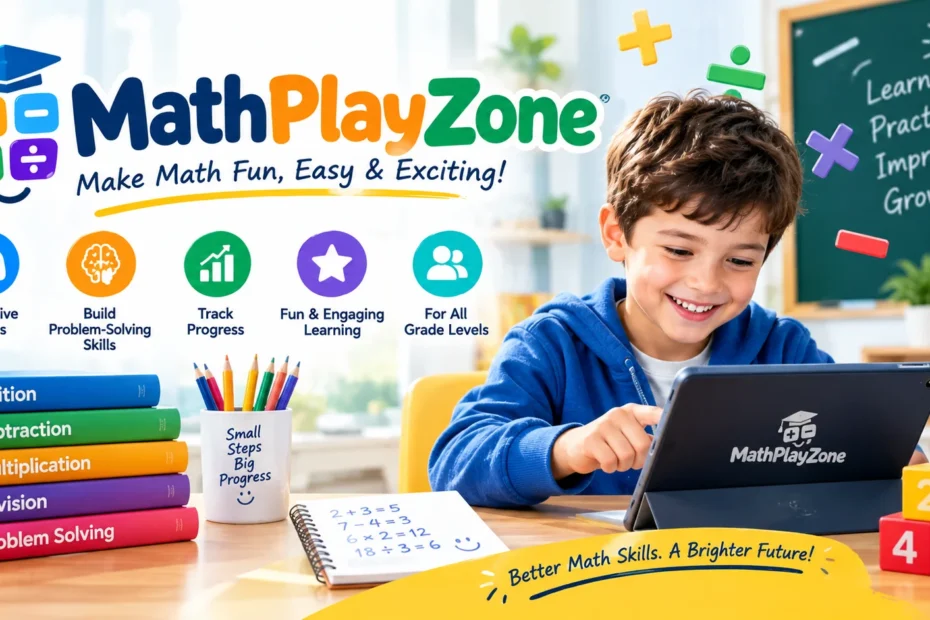
Your child stares at math homework with dread. Forced drills and endless worksheets kill curiosity fast, turning a subject they once enjoyed into a source of daily anxiety. MathPlayZone flips this script by wrapping real math practice inside games kids actually want to play — building genuine skills while they have fun.
What Is MathPlayZone and How Does It Work?
MathPlayZone is an online learning platform built around one simple idea: children absorb math concepts faster when they enjoy the process. The platform delivers interactive math games, timed challenges, and visual puzzles aligned with grade-level standards.
Kids pick a topic, enter a game world, and solve problems to advance through levels. Every correct answer earns points, unlocks new characters, and pushes them toward the next challenge. The system adjusts difficulty automatically based on performance, so no child feels stuck or bored.
Why Do Kids Learn Math Faster Through Play?
Play activates the brain’s reward pathways. When a child solves a puzzle inside a game, their brain releases dopamine — the same chemical tied to motivation and memory formation.
The National Council of Teachers of Mathematics (NCTM) confirms that game-based activities strengthen number sense and problem-solving abilities far more effectively than repetitive worksheet drills (nctm.org). Kids retain concepts longer because they associate the math with a positive emotional experience rather than stress.
Which Math Skills Does MathPlayZone Cover?
The platform spans every core area of elementary and middle school math. Children practice addition, subtraction, multiplication, and division through arcade-style games that reward speed and accuracy.
Fractions, decimals, geometry, and basic algebra appear in higher-level modules. Each skill area includes visual aids like number lines, shape builders, and interactive graphs that make abstract ideas concrete.
How Does MathPlayZone Compare to Other Math Platforms?
Parents often ask how this platform stacks up against popular names like Prodigy Math or Khan Academy. The biggest difference lies in the pure game-first design. Where Khan Academy focuses on video lessons and Prodigy blends RPG elements with math, MathPlayZone keeps every interaction inside a fast-paced game loop.
| Feature | MathPlayZone | Prodigy Math | Khan Academy |
| Primary Format | Arcade-style games | RPG adventure | Video lessons + quizzes |
| Grade Range | K–8 | 1–8 | K–12 |
| Adaptive Difficulty | Yes | Yes | Partial |
| Offline Access | Limited | No | Yes (app) |
| Progress Reports | Weekly email + dashboard | Parent dashboard | Teacher dashboard |
| Cost | Free tier + premium | Free tier + membership | 100% Free |
| Multiplayer Mode | Yes | Yes | No |
| Alignment | Common Core + state | Common Core | Common Core + international |
This table shows that each platform serves a slightly different need. MathPlayZone wins for families who want pure, distraction-free math games without lengthy video lectures.
What Age Groups Benefit Most from MathPlayZone?
Children between ages 5 and 13 see the strongest results. Kindergarteners start with counting games and shape recognition, while seventh and eighth graders tackle pre-algebra puzzles and data interpretation challenges.
The platform groups content into three tiers: Early Learners (K–2), Elementary Builders (3–5), and Middle School Prep (6–8). Each tier uses age-appropriate visuals, language, and reward systems to keep kids engaged.
How Can Parents Track Math Progress on MathPlayZone?
Every account includes a parent dashboard that updates in real time. You can see which topics your child has mastered, where they struggle, and how much time they spend on each activity.
Weekly email summaries break down performance by skill area. If your child consistently misses fraction questions, the report flags it and suggests specific games to close the gap. This transparency removes the guesswork from supporting your child’s math education at home.
What Makes MathPlayZone Different from Traditional Worksheets?
Worksheets test what a child already knows. Games teach what they do not yet understand. When a student makes a mistake on a worksheet, they see a red mark and move on. When they make a mistake inside a MathPlayZone game, the system pauses, shows a visual explanation, and offers a second attempt with a hint.
This instant feedback loop prevents knowledge gaps from widening. The U.S. Department of Education notes that immediate, corrective feedback during practice sessions significantly improves long-term retention in mathematics (ed.gov).
How Do Teachers Use MathPlayZone in Classrooms?
Teachers assign specific game modules as homework or in-class warm-ups. A third-grade teacher might assign the multiplication race game for 15 minutes before introducing a new lesson on arrays.
The teacher dashboard tracks class-wide performance, highlighting which students need extra support. Many educators pair the platform with hands-on activities, using game data to form small intervention groups during math blocks.
What Math Topics Are Available on MathPlayZone?
The content library covers more than 40 distinct topics across eight grade levels. This is an overview of the challenges that students face at each level:
- Kindergarten–1st Grade: Counting to 100, number comparison, basic addition and subtraction, 2D shape identification, simple patterns
- 2nd–3rd Grade: Place value, regrouping, multiplication tables (1–10), telling time, measuring length, introduction to fractions
- Fourth and fifth grade: line plots, area and perimeter, decimal operations, long division, equivalent fractions, and multi-digit multiplication
- 6th–8th Grade: Ratios and proportions, integer operations, solving one-step equations, coordinate graphing, probability, surface area
Each topic includes at least three different game formats so children can approach the same concept from multiple angles.
Is MathPlayZone Safe for Young Children?
Yes. The platform contains zero third-party advertisements and no open chat features. All interactions happen within closed game environments, and parents control account settings through a PIN-protected panel.
Data privacy complies with COPPA (Children’s Online Privacy Protection Act) standards. The company does not sell student data or share it with outside advertisers, giving families peace of mind while their children learn.
How Does Gamified Math Learning Improve Test Scores?
The numbers speak clearly. According to the National Center for Education Statistics, only 26% of U.S. eighth graders scored at or above the proficient level in mathematics on the most recent NAEP assessment (nces.ed.gov). Gamified practice addresses this gap by increasing the total time children willingly spend on math.
When a child plays a math game for 20 minutes by choice, they solve more problems than they would during a 45-minute worksheet session. That extra repetition, paired with positive emotions, translates directly into higher classroom test scores over a single semester.
What Do Parents and Teachers Say About MathPlayZone?
Real feedback from families and educators highlights three recurring themes:
- Engagement: Children ask to play math games instead of resisting homework time.
- Confidence: Struggling learners rebuild their self-esteem after experiencing small, frequent wins inside the games.
- Convenience: The zero-prep setup—create an account, select a grade level, and let the platform take care of the rest—is appreciated by parents.
Teachers report that students who use the platform regularly arrive at class more willing to attempt challenging problems rather than shutting down at the first sign of difficulty.
Start Turning Math Anxiety into Math Confidence Today
Your child deserves to feel excited about numbers, not defeated by them. MathPlayZone gives you a practical, affordable way to rebuild that excitement one game at a time. Set up a free account tonight, pick your child’s grade level, and watch what happens when math stops feeling like a chore and starts feeling like play. The next level is waiting — let your child unlock it.